The current core technical specifications for graphite polystyrene insulation board are based on the newly implemented national standard in 2026 as the rigid acceptance basis, covering product performance, testing methods, and the entire construction process, suitable for the external wall insulation scenarios of industrial plants and self built houses that you are concerned about.
Current core implementation standards
GB/T 30595-2026: Formally implemented on March 1, 2026, graphite modified extruded polystyrene foam (GXPS) was listed in a single technical category for the first time, and the thermal conductivity limit was defined as ≤ 0.030 W/(m · K) (at an average temperature of 25 ℃), which was further tightened than the 0.033 W/(m · K) of the old version of General XPS.
JG/T 536-2026: In 2026, it will synchronously replace the original JG/T 536-2017, stipulating that the combustion performance must reach B1 (B) level (according to GB 8624-2024), and the oxygen index must be ≥ 30%.
GB/T 10801.1-2025: The national standard of molded polystyrene foam plastic for thermal insulation issued in 2025 clearly includes the molded polystyrene board modified with graphite into the control scope, covering the whole process of production and inspection.
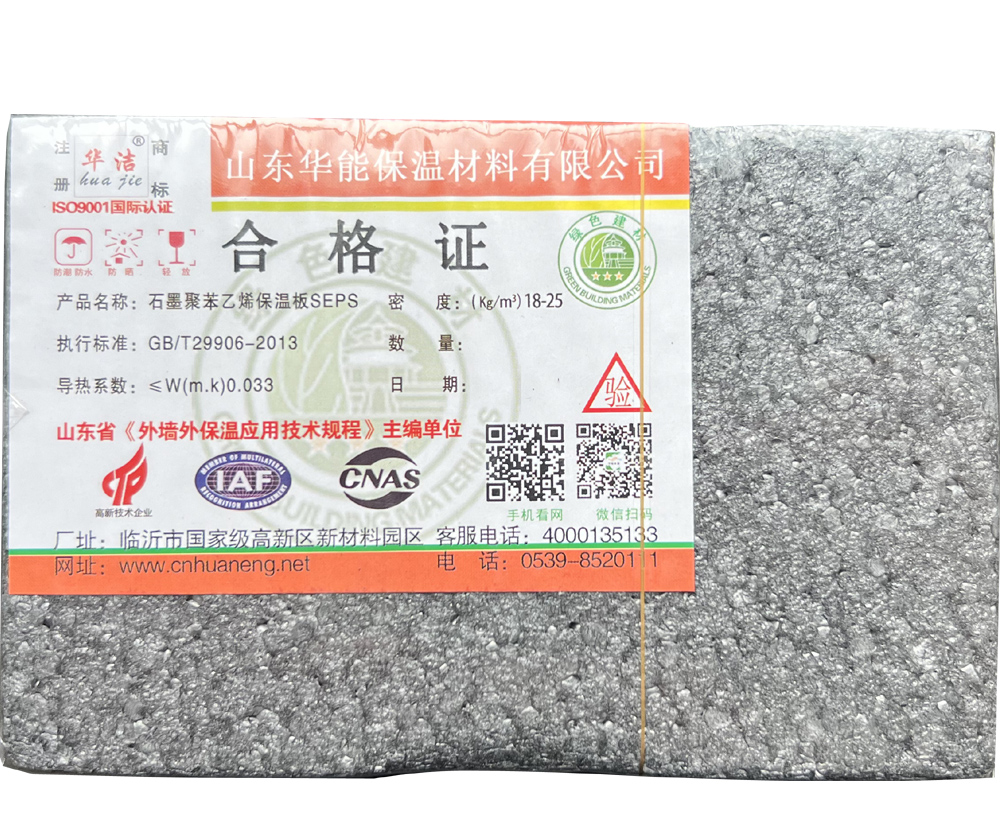
GB/T 29906-2013: Material matching testing basis for molded polystyrene board thin plastering external wall insulation system, is a necessary inspection standard for external wall system acceptance.
Core mandatory performance indicators
Thermal conductivity: ≤ 0.030 W/(m · K) at an average temperature of 25 ℃, far superior to ordinary white EPS board, with insulation efficiency increased by more than 10%.
Combustion performance: It must meet the B1 level flame retardant requirements of GB 8624-2024, carbonize without melting droplets in the event of fire, have an oxygen index of ≥ 30%, and effectively delay the spread of fire.
Apparent density: The conventional qualified range is 18-25 kg/m ³. For local industrial plant scenes in Linyi, it is recommended to choose products with a density of ≥ 20 kg/m ³ to avoid easy breakage and excessive weight that increases wall load.
Compressive strength: ≥ 100 kPa under 10% deformation, and it should be increased to ≥ 200 kPa in high-rise or high-pressure industrial scenarios to prevent long-term compression deformation.
Dimensional stability: After being placed at 70 ℃ for 48 hours, the dimensional change rate should be ≤ 1.5% to avoid cracking of the board and failure of the insulation layer caused by temperature and humidity changes.
New graphite migration index: GB/T 33281-2026 requires quantitative characterization of the surface distribution ratio of graphite in the cell wall, directly controlling the long-term thermal attenuation rate and avoiding a significant decline in insulation performance after 1-2 years of use.
Technical requirements for testing and acceptance
The determination of thermal conductivity must be carried out using the protective hot plate method in accordance with GB/T 10294-2026. Before testing, the sample must be conditioned in an environment of 23 ± 2 ℃ and 50 ± 5% RH for 48 hours, otherwise the data will be invalid.
The combustion performance test strictly follows the GB/T 20284-2024 monomer combustion test method, and the instrument needs to have continuous smoke analysis and flame spread image recognition functions to ensure accurate B1 level judgment.
A handheld infrared thermal imager can be used to determine the uniformity of graphite distribution on the construction site for rapid screening. A digital density meter can be used to measure the density on-site and quickly screen out adulterated products.
All original records of testing must fully include environmental parameters, instrument numbers, and calibration validity periods. The loading rate error of compression strength tests must not exceed ± 5%, and the sampling frequency of displacement sensors must not be less than 10 Hz.
Construction supporting technical specifications
The flatness error of the base wall surface is ≤ 5mm/2m. Cracks and hollowing areas need to be repaired and leveled in advance to avoid the insulation layer falling off in the later stage.
The pasting method adopts the point box method or strip bonding method, with a bonding area of ≥ 40%. The boards are arranged in a staggered manner, and the width of the splicing gap is ≤ 2mm. The gap is filled with insulation mortar to prevent thermal bridge leakage.
The number of anchor installations shall be determined according to the height of the building: no less than 4 per board below the 6th floor, and no less than 6 per board from the 6th to the 18th floor. The anchor installations shall penetrate the wall base by ≥ 50mm.
The total thickness of the plastering layer is controlled at 5-7mm, embedded with alkali resistant fiberglass mesh cloth (mesh size 4mm × 4mm, unit area mass ≥ 160g/㎡), to enhance the crack resistance of the wall.
The height of the exposed insulation board after construction shall not exceed 3 layers, and a plaster layer or protective layer shall be applied in a timely manner to avoid long-term aging under ultraviolet radiation.
The above specifications are currently valid versions in 2026 and can be directly included as technical terms in contracts during procurement and construction to avoid compliance risks during subsequent acceptance.
Shandong Huaneng Insulation Materials Co., Ltd. is a pipeline insulation manufacturer in Linyi. As an integrated insulation and decoration manufacturer in Shandong, our main products include integrated insulation and decoration, pipeline insulation, exterior wall insulation materials, extruded polystyrene board, thermosetting polystyrene board, and rubber insulation. If you need it, you can contact us by phone.
The various information published on this website is for reference only and does not represent the position or viewpoint of this website. It does not constitute any investment, medical, legal or decision-making advice. Any actions taken by users based on the information on this website are at their own risk, and this website does not assume any direct or indirect responsibility. This website does not assume any responsibility for the authenticity, accuracy, completeness, or legality of its content.
Tel: 400-013-5133
Tel: 0539-8520111 15753903111
E-mail: huanengbw@126.com
Address: Linyi National High tech Zone New Materials Park
 Mobile Station
 WeChat